GPU-accelerated inverse problems
Differentiable Physics for MRI
2025–Present · Currently at Stanford University
Automatic differentiation through GPU-accelerated MRI simulations for inverse problems, from RF pulse and sequence design to simulation-based reconstruction.
Why it matters
MRI simulation predicts the signal produced by an experiment. Inverse problems ask the reverse question: which sequence produces a desired response, or which image explains the measured data? Both require repeatedly evaluating a physical model and understanding how its output changes with its inputs. Fast, accurate simulations and automatic differentiation make these optimization problems more practical.
Contribution
I work on making GPU-accelerated MRI simulations differentiable and accurate enough to use inside optimization loops, connecting sequence design and image reconstruction through a common physics-based approach.
RF pulse and sequence design
With Kareem Fareed and collaborators, we use compiler-level reverse-mode automatic differentiation to optimize RF pulses through GPU-accelerated MRI simulations. Our ISMRM abstract presents this approach.
My JuliaCon talk, How I Drew the Julia Logo Using Spins in an MRI Machine, demonstrates it on a scanner: an optimized RF pulse excites a Julia-logo pattern in a water-bottle phantom, using KomaMRI for simulation and Pulseq for acquisition.
Accurate simulations for optimization
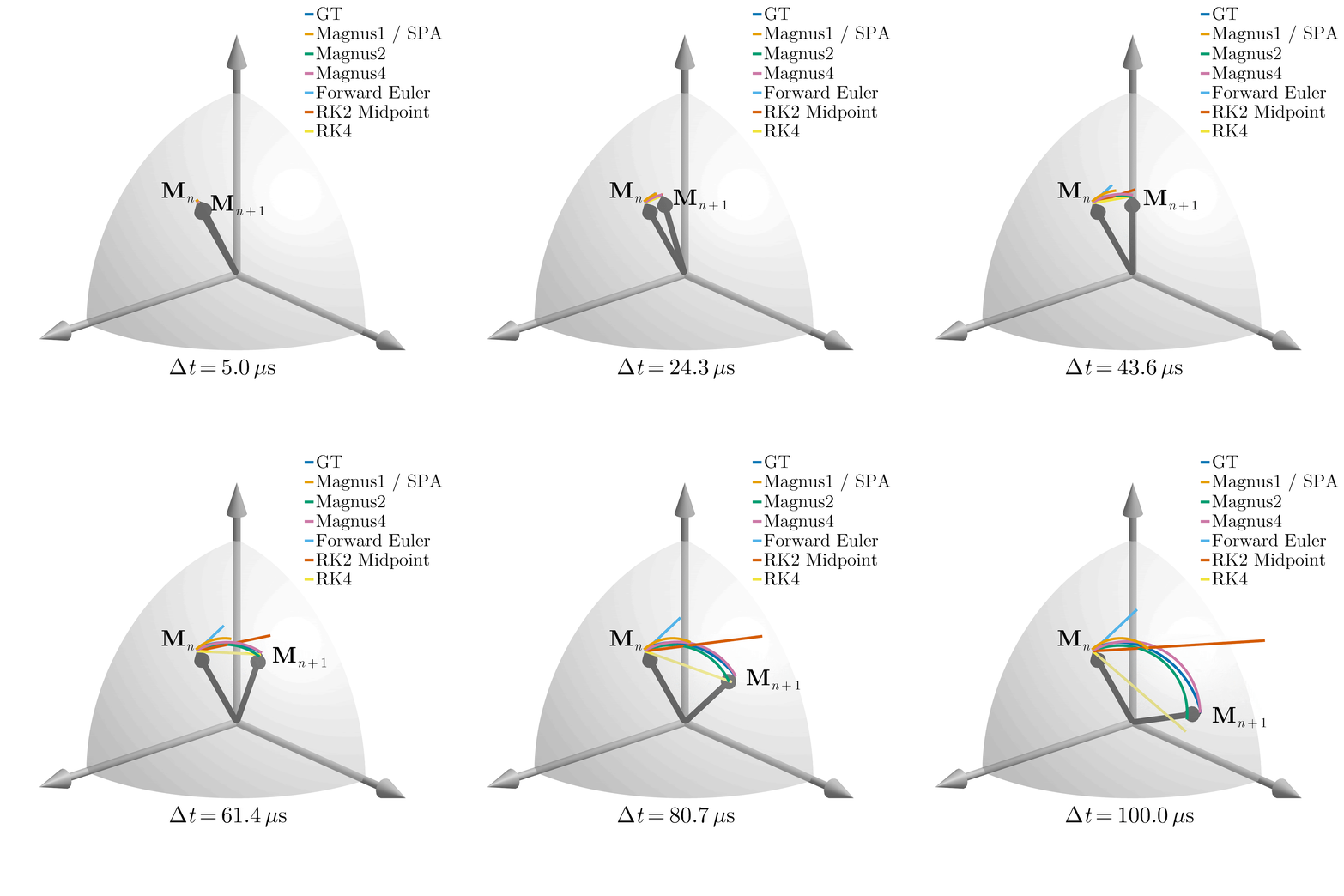
I developed the theory and GPU kernels behind our Magnus-based Bloch simulations. This work improves the speed and accuracy of RF excitation simulations and supports their use in inverse design, where numerical errors in the forward model can lead an optimizer to an incorrect solution.
Project record
Publications and presentations
2026
Oral presentation
How I Drew the Julia Logo Using Spins in an MRI Machine
Health Mini Symposium, JuliaCon 2026 · Mainz, Germany
2026
Digital poster
Highly-Efficient RF Pulse Design via Compiler-Level Reverse-Mode Automatic Differentiation of GPU-Accelerated MRI Simulations
ISMRM 2026 · Cape Town, South Africa
2026
Power pitch
Fast and accurate Bloch simulations using Magnus expansions
ISMRM 2026 · Cape Town, South Africa
Awards & recognition
- 2026 · 3rd Place Trainee Abstract Award, ISMRM Open & Reproducible Research Study Group