Quantitative MRI
Magnetic Resonance Fingerprinting
2024–2025
Motion-compensated diffusion encoding for simultaneous T1, T2, and ADC mapping, with liver validation, 0.55T feasibility studies, and open-source Julia code.
Why it matters
Combining relaxation and diffusion measurements can provide complementary information about liver tissue. Acquiring them together is challenging: motion during diffusion encoding can cause signal loss and unreliable measurements.
Contribution
DiffPrep optimizes motion-compensated gradient waveforms for diffusion-preparation modules. The open-source Julia implementation makes the waveform optimization reproducible and provides the gradients used in our liver MR fingerprinting study.
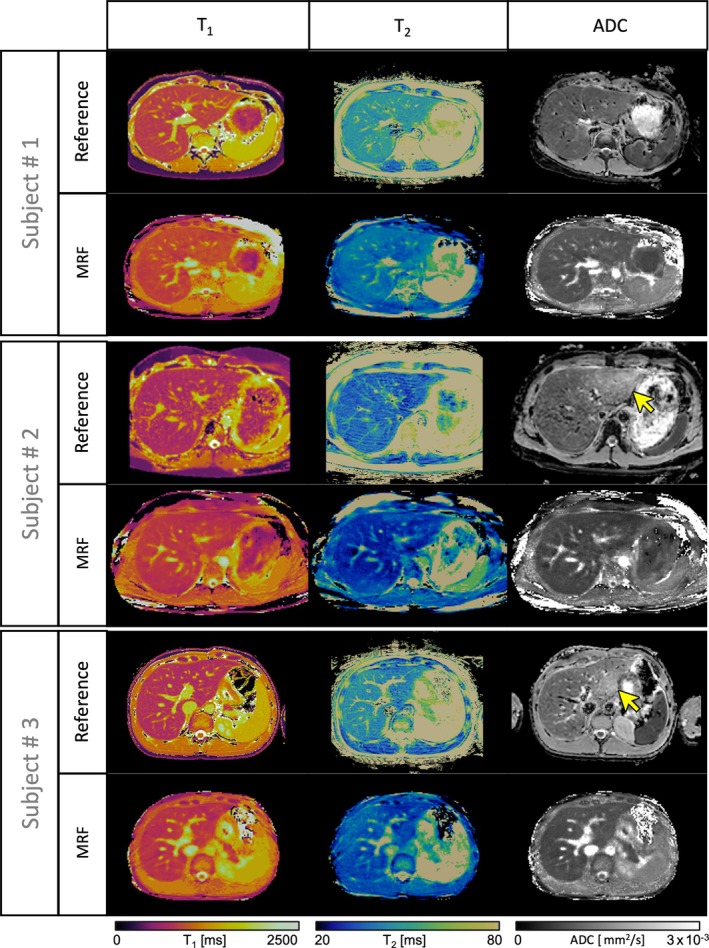
Combined with peripheral pulse triggering and a breath-held acquisition, these preparations enable co-registered T1, T2, and apparent diffusion coefficient (ADC) maps in approximately 16 seconds. The method was evaluated in phantoms and healthy volunteers; evaluation in patients remains future work.
Diffusion-prepared MRF at 0.55T
The low-field feasibility study combines radial bSSFP readouts with inversion recovery, T2 preparation, and optimized diffusion-preparation pulses over 16 heartbeats. Simultaneous T1, T2, and ADC mapping was validated in phantoms against spin-echo references at 0.55T.
Related cardiac T1/T2 MRF at 0.55T
The cardiac studies presented at ISMRM and SCMR 2024 investigate T1 and T2 mapping without diffusion preparation or motion-compensated diffusion gradients. Radial bSSFP acquisitions over 16 heartbeats were evaluated in phantoms and healthy volunteers. These studies establish low-field cardiac MRF feasibility; they are distinct from the diffusion-prepared approach above.
Project record
Publications and presentations
2025
Journal article
Simultaneous liver T1, T2, and ADC MR fingerprinting using optimized motion-compensated diffusion preparations: An initial validation on volunteers
Magnetic Resonance in Medicine
2024
Oral presentation
Liver T1, T2 and ADC Magnetic Resonance Fingerprinting in a single breath-hold at 3T
ISMRM 2024 · Singapore
Awards & recognition
- 2024 · Magna Cum Laude Merit Award (Top 15%), ISMRM
- 2024 · 2nd Place, Trainee Abstract Presentations, ISMRM MR in Drug Research Business Meeting
2024
Power pitch
Cardiac Magnetic Resonance Fingerprinting for Simultaneous T1 and T2 Mapping at 0.55T
ISMRM 2024 · Singapore
2024
Traditional poster
Magnetic Resonance Fingerprinting for Simultaneous T1, T2 and ADC Mapping at 0.55T using Convex-optimized Diffusion Prepared Waveforms
ISMRM 2024 · Singapore
2024
Digital poster
Cardiac Magnetic Resonance Fingerprinting for Simultaneous T1 and T2 Mapping at 0.55T
SCMR 2024 · London, United Kingdom