Open-source MRI simulation
KomaMRI.jl
2022–Present · Currently at Stanford University
Fast, accurate, Pulseq-compatible MRI simulation, with a student-friendly GUI and an extensible API for advanced research.
Why it matters
I started KomaMRI because MRI simulations were slow and difficult to use, and support for simulating sequences defined in the open-source Pulseq format was limited. I wanted to make it practical to test an MRI experiment before taking it to the scanner.
Contribution
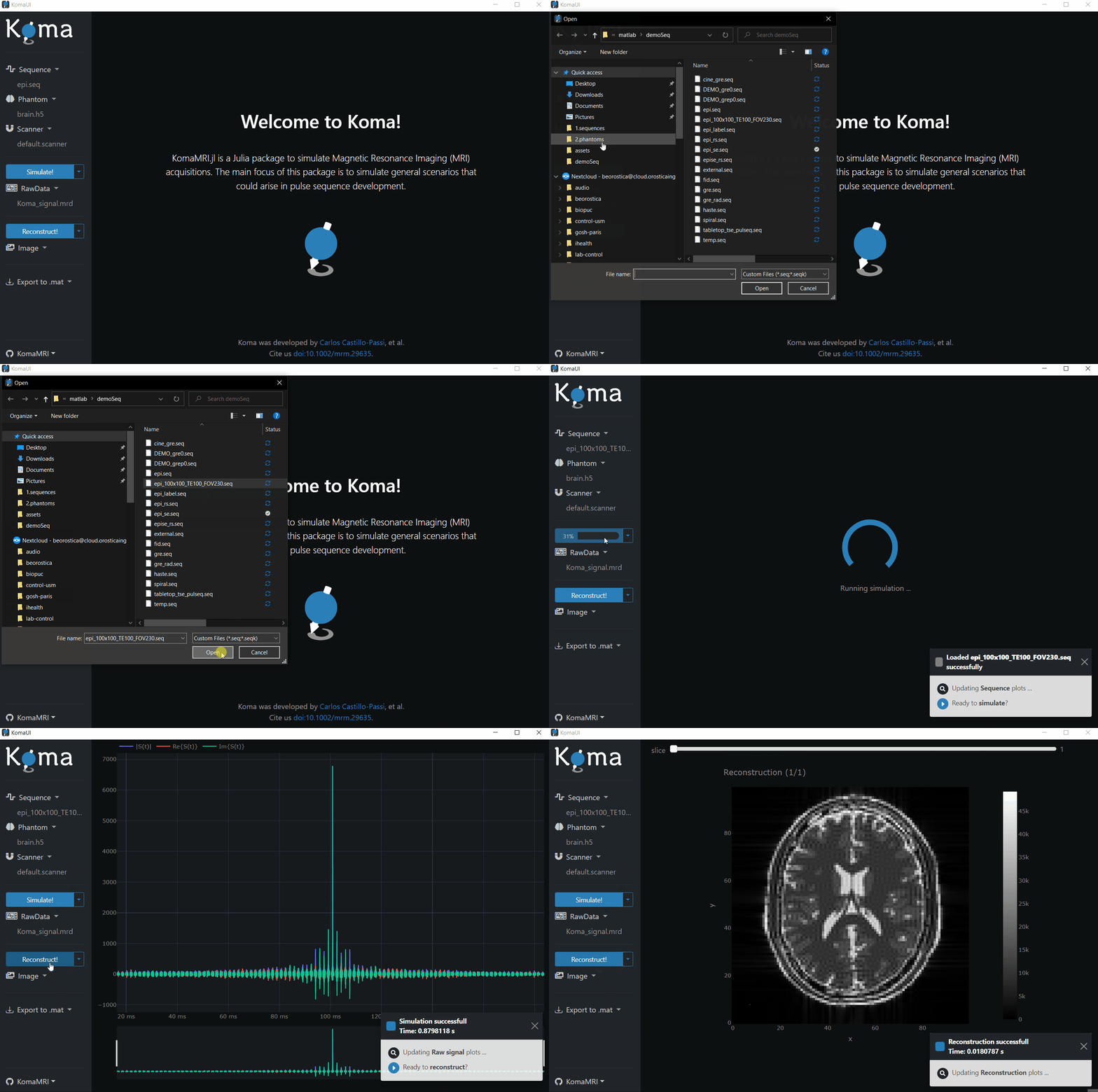
I designed the framework from the ground up for speed, extensibility, and simplicity: a graphical interface for students getting started, and a powerful API for researchers building their own methods. First presented as MRIsim.jl, it connects sequence definitions, digital phantoms, GPU-accelerated simulation, and image reconstruction.
Speed and accuracy
In the original validation study, KomaMRI produced mean absolute differences below 0.1% relative to JEMRIS in the tested simulations. In a separate student experiment, it ran eight times faster than JEMRIS on participants’ personal computers.
More recently, I developed the theory and high-performance GPU kernels behind our Magnus-based Bloch simulations. Higher-order methods improve accuracy at a given time step, or allow larger steps for comparable accuracy; the method documentation explains this trade-off.
I also applied these methods to inverse RF pulse design, demonstrating cases where numerical inaccuracies in existing simulation methods lead to incorrect pulse designs. The key lesson is that a fast forward simulation is not enough: its accuracy matters when an optimizer uses it to design an experiment.
Motion and flow
I was heavily involved in KomaMRI’s arbitrary-motion extension, which we continue to develop at Stanford. It makes motion part of the simulated experiment rather than treating the object as static.
Our ISMRM 2026 flow study provides an initial in-silico evaluation of joint velocity–acceleration encoding for 4D-Flow MRI (4D-FlowP), toward simultaneous flow assessment and more robust pressure-gradient estimation.
Open development
As of September 8, 2026, KomaMRI on GitHub has 220 stars and 26 contributors, excluding bot accounts. Community contributions expand the framework, including its GPU support and motion capabilities. The documentation brings together introductory tutorials, reproducible MRI examples, and an API reference for advanced users.
Project record
Publications and presentations
2026
Invited educational talk
Introduction to numerical phantoms and MRI sequence simulation with KomaMRI
MRITogether 2026 · Virtual meeting
2026
Journal article
Versatile and Highly Efficient MRI Simulation of Arbitrary Motion in KomaMRI
Magnetic Resonance in Medicine
2026
Oral presentation
How I Drew the Julia Logo Using Spins in an MRI Machine
Health Mini Symposium, JuliaCon 2026 · Mainz, Germany
2026
Invited educational talk
Open-Source Frameworks for MRI Reconstruction II
Demystifying MRI Reconstruction: Classical Foundations to AI Frontiers, ISMRM 2026 · Cape Town, South Africa
2026
Power pitch
Simulation and Evaluation of Joint Velocity-Acceleration Encoded 4D-Flow MRI
ISMRM 2026 · Cape Town, South Africa
2026
Digital poster
Highly-Efficient RF Pulse Design via Compiler-Level Reverse-Mode Automatic Differentiation of GPU-Accelerated MRI Simulations
ISMRM 2026 · Cape Town, South Africa
2026
Power pitch
Fast and accurate Bloch simulations using Magnus expansions
ISMRM 2026 · Cape Town, South Africa
Awards & recognition
- 2026 · 3rd Place Trainee Abstract Award, ISMRM Open & Reproducible Research Study Group
2026
Oral presentation
Fast and accurate Bloch simulations using Magnus expansions
ISMRM 2026 Workshop on Data Sampling and Image Reconstruction · Sedona, USA
2025
Invited talk
Go with the Flow: Using Extensible and Shareable Motion Phantoms in KomaMRI
MRITogether 2025 · Virtual meeting
2025
Invited educational talk
Modern Open-Source MRI Simulations
Open Innovation in MR from Vendor & Academia Perspective, ISMRM 2025 · Honolulu, USA
2025
Oral presentation
What's New with KomaMRI.jl
JuliaHealth Minisymposium, JuliaCon 2025 · Pittsburgh, USA
2025
Oral presentation
KomaMRI.jl Device-Agnostic, Highly Efficient, and Pulseq-compatible MRI Simulations
SCMR 2025 · Washington, DC, USA
2023
Journal article
KomaMRI.jl: An Open-Source Framework for General MRI Simulations with GPU Acceleration
Magnetic Resonance in Medicine
Awards & recognition
- 2025 · Top Viewed Article in MRM (Top 10%)
- 2023 · Editor's Pick, Magnetic Resonance in Medicine
2023
Invited talk
KomaMRI.jl: Framework for MRI Simulations with GPU Acceleration
MRITogether 2023 · Virtual meeting
2023
Invited talk
Using KomaMRI.jl for Comprehensive Quantitative MRI
Vendor-Agnostic Pulse Sequence Programming with Pulseq: From Basics to Advanced Topics, ISMRM 2023 · Virtual meeting
2023
Oral presentation
KomaMRI.jl: Framework for MRI Simulations with GPU Acceleration
JuliaCon 2023 · MIT, Cambridge, USA
2022
Digital poster
MRIsim.jl: A framework for end-to-end spin-level MRI simulations with GPU acceleration
ISMRM & SMRT Annual Meeting 2022 · London, United Kingdom